
In fiscal year 2025, the selection rate for the U.S. H-1B lottery plummeted below 30%, leaving thousands of organizations with empty desks and wasted legal fees. While most HR departments are gambling their talent acquisition strategy on a random draw, a specialized few are bypassing the chaos entirely through disciplined H-1B1 visa sponsorship management. It's frustrating to find a top-tier candidate only to lose them to a lottery system you can't control. You've likely experienced the administrative burden of tracking complex compliance trails and the sting of losing elite talent to a cap that doesn't account for your operational needs.
This article provides the blueprint to master the H-1B1 lifecycle, allowing you to secure specialized professionals from Chile and Singapore with total certainty. We'll show you how to replace lottery luck with a methodical strategy that reduces sponsorship costs and ensures bulletproof audit documentation. You'll learn the precise steps to maintain a predictable hiring timeline, moving from international talent sourcing to audit-ready reporting without the typical legal overhead. We're moving beyond the guesswork of traditional immigration and focusing on high-performance recruitment logistics that treat talent acquisition as a manageable business process.
Key Takeaways
- Discover how to bypass the H-1B lottery entirely by leveraging underutilized treaty-based quotas reserved for Chile and Singapore nationals.
- Implement a rigorous H-1B1 visa sponsorship management framework to centralize your Public Access Files and ensure constant audit readiness.
- Secure specialized talent in critical fields like fintech, AI, and renewable energy without the risk of losing top candidates to a random draw.
- Reduce administrative friction and high legal overhead by transitioning from traditional consultancy to a disciplined, operational sponsorship model.
- Establish a predictable hiring timeline that allows your HR team to scale international talent with precision and accountability.
The Strategic Shift: Why H-1B1 Visa Sponsorship Management Outperforms the Lottery
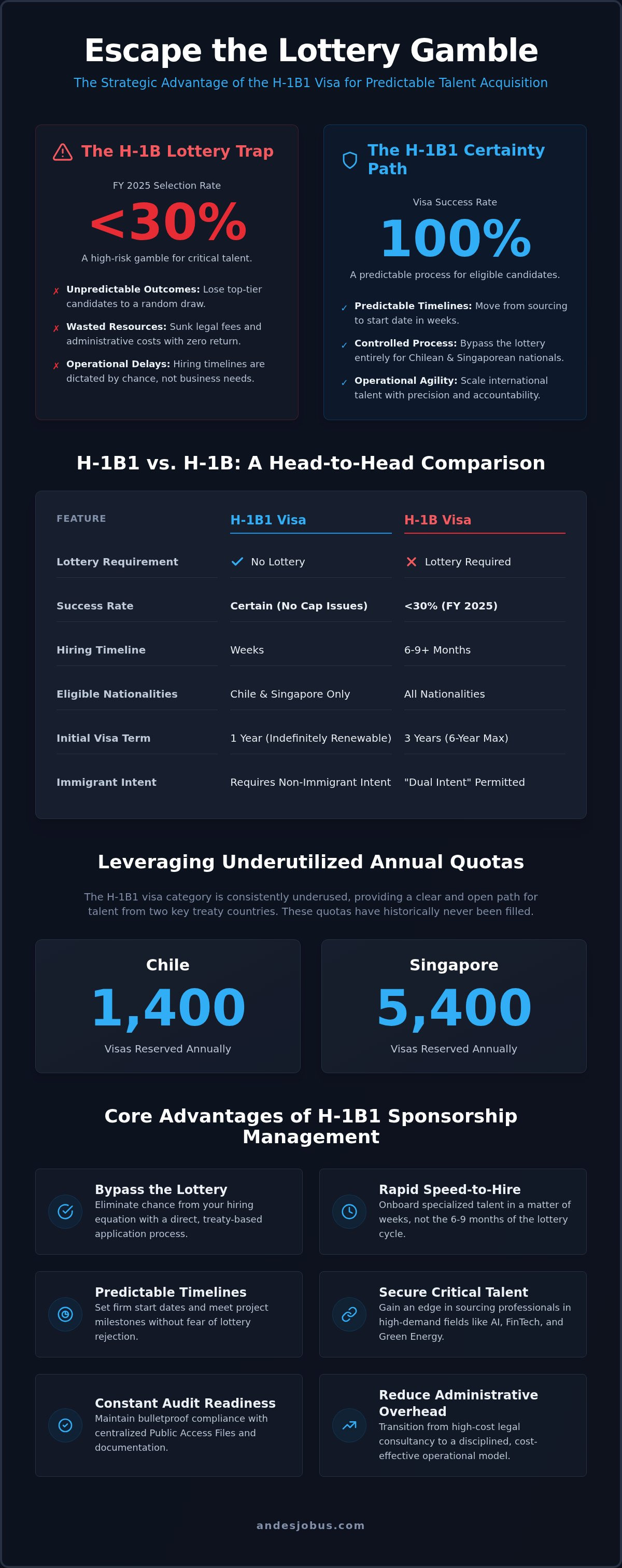
The traditional H-1B lottery has evolved into a high-risk gamble that most corporate leaders can no longer afford. For fiscal year 2025, selection rates dropped below 30%, forcing companies to abandon critical hiring plans after months of preparation and investment. This "Lottery Trap" creates massive operational friction and wastes significant capital on legal fees with zero guaranteed return. Transitioning to H-1B1 visa sponsorship management allows your organization to treat international hiring as a predictable business process rather than a game of chance. By focusing on professionals from Chile and Singapore, you leverage specific trade agreements that offer a 100% certain timeline.
The H-1B1 visa is a treaty-based category that provides a streamlined path for specialty occupations. Unlike the standard H-1B, which is buried under a massive backlog, the H-1B1 program is consistently underutilized. This lack of competition means your recruitment team can set firm start dates and meet project milestones without the constant threat of a lottery rejection. Predictability becomes your primary KPI, replacing the "lottery fatigue" that often plagues HR departments and finance teams.
H-1B1 vs. H-1B: Key Structural Differences
The most significant advantage is the cap-exempt status. There are 1,400 slots reserved for Chilean nationals and 5,400 for Singaporeans annually. These quotas rarely fill up, which eliminates the need for a lottery system entirely. While the H-1B typically grants a three-year block, the H-1B1 operates in one-year increments. This requires a disciplined approach to renewal cycles, but it also offers more flexibility for project-based needs. It's important to recognize that the H-1B1 requires non-immigrant intent. While this differs from the "dual intent" of an H-1B, it serves as a tactical tool for securing specialized experts for defined operational periods without the long-term complexity of permanent residency tracks.
The Business Case for Treaty-Country Sourcing
Speed to hire is the primary metric here. You can move from candidate selection to an active start date in weeks, not the six-to-nine-month window required by the traditional lottery cycle. High-performance H-1B1 visa sponsorship management removes the $100,000+ sunk cost often associated with failed H-1B petitions and endless legal consultations. By targeting these specific talent hubs, you gain operational agility. You aren't just filling a seat; you're deploying a specialized expert through a reliable, high-speed pipeline that your finance and HR teams can actually track and forecast with precision.
The H-1B1 Framework: Leveraging Free Trade Agreements for Talent
The H-1B1 visa isn't a traditional immigration program; it's a direct result of the United States-Chile and United States-Singapore Free Trade Agreements. These treaties allow U.S. employers to access specific talent pools without the friction of the standard H-1B lottery. Success in this category requires a shift in perspective. You aren't just filing paperwork. You're executing a trade-based talent strategy. Central to this process is the Labor Condition Application (LCA), which serves as your public commitment to fair labor practices. It requires you to document that you'll pay the prevailing wage, ensuring your international hires don't undercut local market standards. Effective H-1B1 visa sponsorship management starts with these compliance fundamentals to prevent future audit triggers.
Operational compliance isn't a one-time event. It requires constant monitoring of wage levels and job duties to ensure they remain aligned with Department of Labor (DOL) standards. By establishing these guardrails early, you protect your organization from the administrative chaos often found in less disciplined sponsorship models. You can streamline this process by integrating professional H-1B1 visa sponsorship management into your existing HR workflow, ensuring every hire is backed by rigorous documentation.
Eligibility Criteria for US Employers
Proving eligibility is about precision, not volume. You must demonstrate that the role is a "Specialty Occupation" and that the candidate holds the necessary credentials. Under the H-1B1 framework, a specialty occupation is defined as a role that requires the theoretical and practical application of a body of highly specialized knowledge, typically evidenced by a bachelor's degree or higher in that specific field. You'll need to map the candidate's degree directly to the job duties. For Chilean and Singaporean nationals, this means providing clear evidence of citizenship and specialized academic qualifications that meet U.S. standards.
The H-1B1 Timeline: From Sourcing to Onboarding
Timing is your most valuable asset. The LCA filing window is your first hurdle. You can't file more than six months before the intended start date, but you shouldn't wait until the last minute. In 2026, consular processing remains the fastest path for most candidates. Since the H-1B1 doesn't offer premium processing, filing for a Change of Status (COS) within the U.S. can lead to unpredictable delays. Consular appointments in Santiago or Singapore are often more efficient. During the interview phase, you must address the "Non-Immigrant Intent" requirement. Unlike the H-1B, H-1B1 applicants must show they intend to return home eventually. Your management team should be trained to identify candidates whose professional goals align with this temporary status while still maximizing their impact on your organization.
End-to-End Lifecycle Management: Compliance, LCA, and Audit Protection
Securing a visa is only the first stage of a successful international talent strategy. Real operational success depends on how you manage the years that follow. Effective H-1B1 visa sponsorship management requires a shift from reactive paperwork to proactive lifecycle oversight. Compliance is binary. You either have the documentation required by the DOL Wage and Hour Division, or you face significant financial exposure. Centralizing your Public Access File (PAF) is the foundation of this discipline. It ensures that every piece of evidence, from wage determinations to internal notices, is organized and accessible long before an auditor knocks on your door.
Post-onboarding management involves more than just filing a folder away. You must track status changes, role modifications, and geographic moves in real time. If a specialized engineer moves from your Austin office to a remote setup in Denver, your LCA must reflect that change. Failing to monitor these shifts creates a compliance gap that can invalidate a visa. We treat these administrative requirements as predictable business processes, removing the stress of uncertainty through rigorous tracking and clear accountability.
Building a Bulletproof Public Access File
Your PAF must be a complete narrative of your compliance efforts. It should include the prevailing wage determination and a clear "actual wage" memo explaining how you calculated the hire's salary relative to their peers. You must also include evidence of notice, proving you informed your existing workforce of the LCA filing. For high-growth firms, digital records are the standard. They allow for instant retrieval during an inspection and ensure that nothing is lost in a physical filing cabinet. Every document should be dated and signed, creating a transparent trail that demonstrates your commitment to DOL standards.
Managing the H-1B1 Renewal Cycle
There's a common myth that H-1B1 renewals are indefinite and automatic. In reality, they occur in one-year increments, which demands a high level of operational discipline. You can't afford to miss a filing window. We recommend initiating the renewal process at least 90 days before expiration to avoid any gaps in work authorization. This cycle also provides a strategic checkpoint. It's a time to evaluate whether the candidate should remain on an H-1B1 or if it's time to transition to a different category. By maintaining a fleet-wide view of expiration dates, you ensure that your specialized talent remains focused on their work rather than their status. This level of H-1B1 visa sponsorship management transforms a complex legal requirement into a streamlined part of your annual talent review.
Sourcing Specialized Talent: The Chile and Singapore Advantage
Accessing the right talent requires more than just a legal pathway; it requires a direct connection to the world’s most disciplined innovation hubs. Chile and Singapore aren't just treaty partners. They're centers of excellence in sectors that drive the modern economy. By focusing your recruitment efforts on these specific regions, you bypass the saturated global markets and tap into specialized expertise that aligns with U.S. business standards. Integrating H-1B1 visa sponsorship management into your sourcing strategy allows you to secure these high-performers with a level of speed and certainty that the standard lottery cannot match.
Professional alignment is a key driver of success in these markets. Candidates from Chile and Singapore often possess a high degree of cultural and professional compatibility with U.S. corporate environments. This synergy reduces onboarding time and ensures that your new hires can contribute to high-stakes projects immediately. We treat talent sourcing as a precision operation, identifying professionals who are already "visa-ready" and meet the strict specialty occupation requirements of the H-1B1 category.
Tapping into the Chilean Tech Ecosystem
Santiago has emerged as a powerhouse for engineering and technical innovation. The Chilean educational system is rigorous, producing experts in mining technology, renewable energy, and civil engineering who are uniquely suited for industrial applications. Evaluating educational equivalents is a standard part of our methodology to ensure Chilean degrees meet USCIS standards. Chilean engineers provide essential technical expertise for large-scale US infrastructure and energy projects due to their rigorous academic training and experience in complex terrain environments. This specialized background makes them invaluable assets for firms managing complex physical and digital assets.
Singaporean Professionals: Fintech and AI Leadership
Singapore is the global gold standard for fintech, artificial intelligence, and supply chain logistics. Their workforce is English-proficient, globally-minded, and trained in one of the world’s most competitive business environments. Navigating the Singapore FTA nuances allows for faster consular turnarounds, often moving candidates through the pipeline in a fraction of the time required for other visa types. Because the 5,400 annual slots for Singaporeans are consistently underutilized, your organization can hire high-level financial and technical experts without the fear of a cap-related rejection. This predictability is the cornerstone of our H-1B1 visa sponsorship management approach.
Stop gambling on the lottery and start building a reliable talent pipeline. You can secure elite professionals today by leveraging our International Talent Sourcing services to find your next specialized hire.
Scaling Your International Team with AndesJobUSA
Most organizations struggle with international hiring because they treat immigration as a legal hurdle rather than an operational supply chain. AndesJobUSA changes this dynamic. We move beyond traditional "legal advice" to provide comprehensive H-1B1 visa sponsorship management that functions as a disciplined business process. By integrating international talent sourcing with rigorous sponsorship logistics, we remove the friction that typically slows down high-stakes recruitment. You gain a partner that takes full ownership of the timeline, from the initial candidate search to the final compliance audit.
Transparency is a requirement for modern HR and Finance leadership. Our management systems provide real-time tracking of your entire candidate pipeline, giving you total visibility into every stage of the process. This methodical progression is how we help you forge the $100,000 fee often lost to high-risk lottery entries and inefficient legal overhead. We treat your hiring budget with the same precision you do, focusing on predictable results rather than administrative guesswork. It's about building a talent pipeline that is as reliable as your domestic hiring tracks.
The AndesJobUSA Operational Model
We act as a seamless extension of your internal team, bridging the gap between recruitment and compliance. Our model follows a disciplined, step-by-step progression that ensures no detail is overlooked. We manage the heavy lifting of documentation, including the creation and maintenance of your Public Access Files. This proactive audit support means your team stays focused on core business goals while we handle the regulatory logistics. Our approach is characterized by:
- Direct ownership of the LCA filing and tracking lifecycle.
- Rigorous verification of candidate credentials and specialty occupation status.
- Continuous monitoring of renewal windows to prevent work authorization gaps.
- Professional reporting that aligns with corporate finance and auditing standards.
Next Steps: Risk-Free International Hiring
Initiating a talent search for Chilean or Singaporean experts is a straightforward process. We identify visa-ready professionals who meet your specific technical requirements and verify their credentials before they ever reach your interview stage. This pre-screening process ensures that you only spend time on candidates who are eligible for the H-1B1 category. You can establish your full H-1B1 compliance framework in under 30 days, allowing you to scale your team with speed and confidence. We provide the structure; you provide the vision. Ready to bypass the lottery? Explore H-1B1 Sponsorship Management with AndesJobUSA.
Master Your Global Talent Pipeline Today
The era of relying on the H-1B lottery as your primary source for international talent is over. The H-1B1 category provides a predictable, cap-exempt path for hiring specialized experts from Chile and Singapore. By implementing a rigorous system for H-1B1 visa sponsorship management, you transform a high-risk gamble into a manageable business process. This approach secures elite talent and ensures your organization remains audit-ready with bulletproof documentation for every hire. You've now moved beyond the uncertainty of random draws toward a disciplined, treaty-based recruitment model.
AndesJobUSA acts as a seamless extension of your HR and Finance teams. We combine international talent sourcing with end-to-end compliance oversight to remove the administrative burden from your internal staff. You don't have to navigate complex treaty nuances alone or fear the high costs of failed petitions. It's time to build a talent acquisition strategy rooted in discipline and operational clarity. Our methodical framework protects your bottom line and delivers the specialized leadership your projects demand.
Schedule a Strategic H-1B1 Consultation with AndesJobUSA and start hiring with total certainty. You're now ready to scale your team with precision and confidence.
Frequently Asked Questions
What is H-1B1 visa sponsorship management?
H-1B1 visa sponsorship management is the operational oversight of the entire visa lifecycle for professionals from Chile and Singapore. It moves beyond simple filing to include talent sourcing, Labor Condition Application (LCA) tracking, and the maintenance of audit-ready Public Access Files. This disciplined approach ensures that your organization secures specialized talent without the administrative friction or uncertainty typical of traditional immigration pathways.
How many H-1B1 visas are available for Chile and Singapore annually?
There are 6,800 H-1B1 visas available annually, specifically divided between two treaty nations. Chile is allocated 1,400 slots, while Singapore receives 5,400. These quotas are established by Free Trade Agreements and remain consistent. Because these numbers are rarely exhausted, employers can hire with a level of certainty that is impossible under the general H-1B cap.
Is the H-1B1 visa subject to the same lottery as the H-1B?
No, the H-1B1 visa is not subject to the H-1B lottery system. It operates outside the random selection process because the annual treaty quotas are consistently underutilized. This allows U.S. employers to bypass the "Lottery Trap" and set predictable start dates for their candidates. You don't have to wait for an annual window to secure the specialized expertise your projects require.
Can H-1B1 visa holders apply for a Green Card?
The H-1B1 is strictly a non-immigrant visa, meaning applicants must demonstrate an intent to return home eventually. Unlike the H-1B, it doesn't officially support "dual intent." While holders can't directly use the H-1B1 as a stepping stone to permanent residency, they can transition to other visa categories later. Strategic planning helps manage these transitions without disrupting your operational stability.
How long does the H-1B1 visa sponsorship process take for US employers?
The H-1B1 process is significantly faster than the standard H-1B cycle, often taking only a few weeks from candidate selection to onboarding. Consular processing in Santiago or Singapore is the most efficient route in 2026. Because there's no lottery requirement, your H-1B1 visa sponsorship management timeline remains predictable and aligned with your immediate business needs.
What are the employer's LCA compliance obligations for H-1B1 workers?
Employers must file a Labor Condition Application (LCA) and maintain a Public Access File for every H-1B1 hire. Your obligations include paying the prevailing wage and documenting that you've notified your existing workforce of the filing. Maintaining these records is a binary requirement; you're either in compliance or exposed to significant penalties during a Department of Labor inspection.
Can an H-1B1 visa be renewed indefinitely?
While the H-1B1 can be renewed, it isn't an indefinite authorization. Renewals occur in one-year increments, and the candidate must continue to prove their non-immigrant intent during each consular interview. This requires a high level of administrative discipline to track expiration dates and initiate renewal filings early. It's a manageable process that rewards proactive oversight and clear documentation.
What happens if a company is audited for H-1B1 compliance?
If the DOL Wage and Hour Division conducts an audit, they'll scrutinize your Public Access Files and payroll records. They check for prevailing wage compliance, actual wage memos, and evidence of employee notification. Having a centralized, digital compliance framework allows you to respond to these inspections with confidence. Disciplined H-1B1 visa sponsorship management ensures that an audit is a routine check rather than a crisis.