
Your next critical hire shouldn't depend on a random number generator. Most US employers have felt the sting of losing the H-1B lottery, watching top-tier talent slip away because of a system built on luck rather than merit. It's frustrating to align your business goals with federal filing windows only to be told your growth is on hold. Establishing a clear H-1B1 visa sponsorship timeline allows you to bypass this chaos and move forward with operational certainty.
You don't have to settle for the gamble of the standard H-1B cap. This guide transforms that unpredictability into a disciplined, 8-week process. You'll master the sponsorship lifecycle and put yourself back in control of your recruitment schedule. By leveraging the specific quotas for Chile and Singapore, you can secure specialized talent with a level of precision that the lottery simply cannot offer.
We'll break down the lifecycle of sponsoring these professionals, from Labor Condition Application filing to final consular processing. You'll learn how to manage each phase to ensure your documentation is audit-ready and your hiring remains on track. This is about moving from administrative guesswork to a high-performance, manageable business process that delivers results.
Key Takeaways
- Execute a predictable 8-week H-1B1 visa sponsorship timeline to secure specialized talent without the risks associated with the H-1B lottery.
- Leverage specific treaty-based quotas for Chile and Singapore to maintain a consistent flow of international professionals into your organization throughout the fiscal year.
- Implement proactive compliance measures to avoid "Requests for Evidence" (RFEs) that can delay your hiring schedule by four to six weeks.
- Transition from high-stakes legal uncertainty to a streamlined, audit-ready operational process that treats international sponsorship as a manageable business function.
Understanding the H-1B1 Advantage: Why the Timeline Matters
For most US companies, the standard H-1B lottery is a logistical bottleneck that hampers aggressive growth. The H-1B1 visa category offers a strategic escape from this cycle. It's a treaty-based Specialty Occupation classification designed specifically for professionals from Chile and Singapore. Unlike the general H-1B, which is capped and subject to a high-stakes lottery, the H-1B1 operates under a distinct framework. This means your H-1B1 visa sponsorship timeline isn't dictated by an annual drawing, but by your own business needs. For a detailed H-1B1 visa overview, employers can review the foundational treaty requirements that govern this classification.
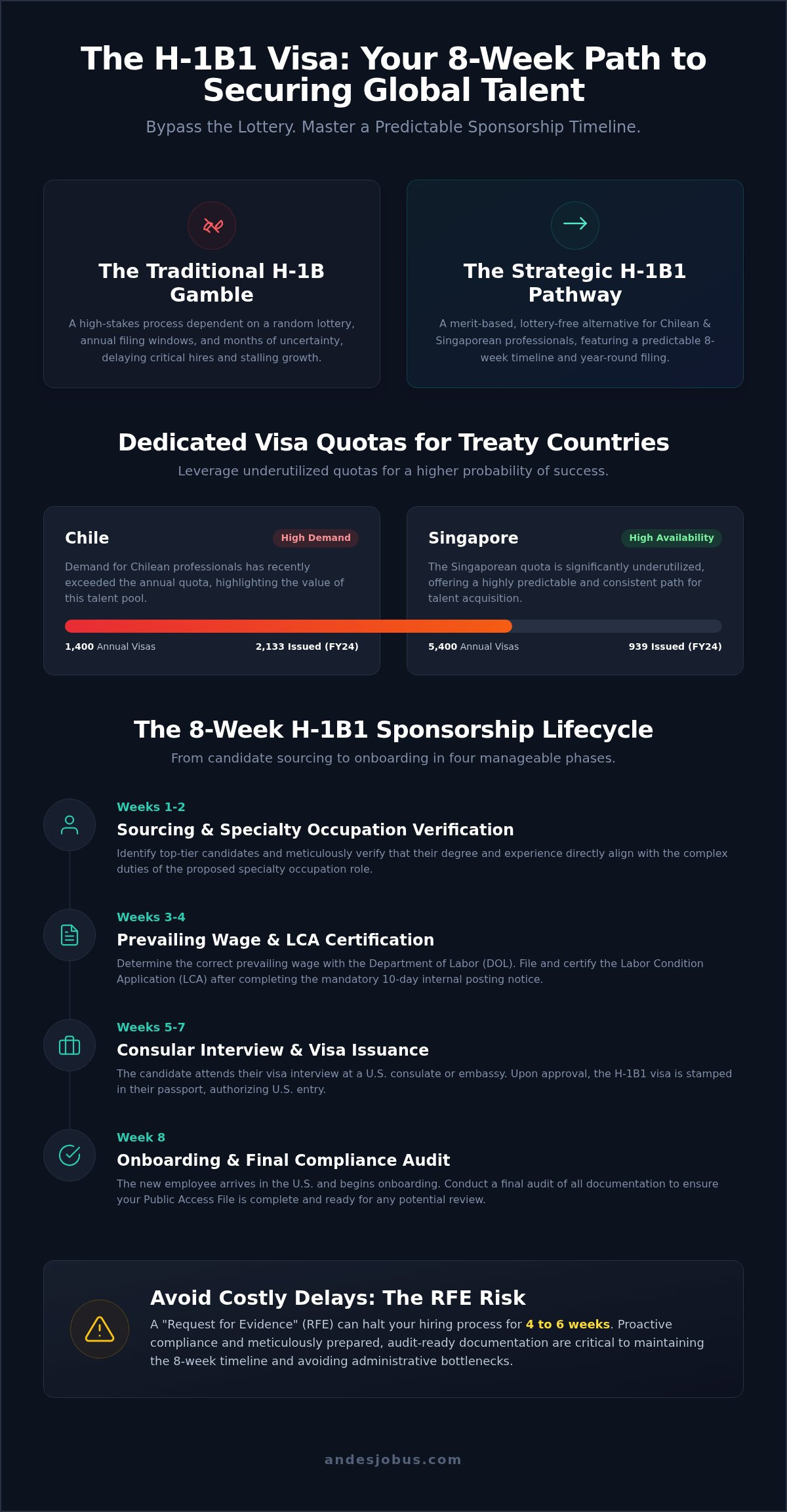
Operating in the 2026 fiscal year requires a shift from legal gambling to operational discipline. The H-1B1 program provides 1,400 visas for Chilean citizens and 5,400 for Singaporean citizens annually. While the Singaporean quota is rarely met, the Chilean cap has seen increased demand recently. In 2024, for instance, only 939 of the 5,400 available slots were issued to Singaporeans, while Chile saw 2,133 issuances. This availability transforms international talent acquisition from a seasonal event into a year-round business process. You can source, interview, and onboard a specialized engineer or analyst whenever your project requires it, rather than waiting for the next April filing window.
H-1B1 vs. Traditional H-1B: A Speed Comparison
Traditional H-1B filings require months of lead time and an April 1st submission just to enter a lottery that many applicants will lose. The H-1B1 timeline is measured in weeks. Because it's exempt from the standard cap, you can initiate a hire in July, October, or any month that suits your project roadmap. The H-1B1 visa provides a lottery-free pathway for Chile and Singapore nationals to work in the US. By removing the April 1st filing deadline constraint, you gain a massive competitive advantage in securing high-demand talent before your competitors can even submit a registration.
Targeting Treaty Countries: Chile and Singapore
Santiago and Singapore are world-class hubs for tech, finance, and engineering talent. The Free Trade Agreement (FTA) framework was built to facilitate this specific talent flow. These candidates often possess the exact specialized skills US firms struggle to find locally. Because the quotas for these countries are managed separately, the probability of securing a visa is significantly higher than in the general pool. In Singapore's case, the massive underutilization of the 5,400-visa quota means the H-1B1 visa sponsorship timeline remains highly predictable. You're no longer competing with the entire world for a handful of slots; you're utilizing a dedicated lane designed for efficiency.
The 8-Week H-1B1 Sponsorship Lifecycle: Step-by-Step
Executing a successful H-1B1 visa sponsorship timeline requires a transition from reactive hiring to proactive project management. By following a disciplined 8-week roadmap, you can move a candidate from initial sourcing to their first day on the job with operational certainty. This process isn't about navigating legal mysteries; it's about hitting specific administrative milestones with precision. Your 8-week roadmap breaks down into four distinct phases:
- Weeks 1-2: Candidate sourcing and specialty occupation verification.
- Weeks 3-4: Prevailing wage determination and LCA certification.
- Weeks 5-7: Consular interview and visa issuance.
- Week 8: Onboarding and final compliance audit.
Weeks 1 and 2 are about talent sourcing and internal alignment. You aren't just finding a candidate; you're verifying that their degree specifically aligns with the job duties to satisfy the specialty occupation requirement. This period is the foundation of your entire H-1B1 visa sponsorship timeline. If the sourcing is flawed, the subsequent legal filings will fail. You must ensure the candidate's background matches the complexity of the role from day one.
Stage 1: Prevailing Wage and LCA Certification
During Weeks 3 and 4, the focus shifts to the Department of Labor (DOL). You must determine the correct Standard Occupational Classification (SOC) code to set the prevailing wage. The Labor Condition Application (LCA) is a formal attestation that your company will provide working conditions and wages that don't adversely affect US workers. You must post the notice of filing internally for ten business days. Maintaining a transparent record of this posting is critical for your compliance and audit documentation. The DOL certification window typically takes seven to ten days, and having an audit-ready file at this stage prevents future delays.
Stage 2: Filing Strategies (USCIS vs. Consular)
The consular processing phase in Weeks 5 through 7 involves the candidate attending an interview at a US embassy in Santiago or Singapore. Because the H-1B1 does not require a pre-approved I-129 petition for initial entry, the candidate brings the certified LCA and their offer letter directly to the consulate. This streamlined approach is why the H-1B1 is often called a high-speed visa. It removes the administrative layer of USCIS adjudication for those abroad. Understanding the H-1B1 visa cap allocation is essential here, as these slots are set aside specifically for treaty nationals.
Week 8 is the finish line. You finalize the onboarding process and ensure the candidate's I-9 documentation is compliant. It's also the time to double-check that your public access file contains the required wage data and LCA copies. You can streamline your international talent pipeline by integrating these milestones into your standard HR workflow, turning a complex immigration hurdle into a predictable business process.
H-1B1 Visa Timeline Risks: Avoiding the RFE
A disciplined 8-week schedule is only as strong as the documentation supporting it. Even with the H-1B1’s streamlined nature, administrative errors can trigger a Request for Evidence (RFE), which instantly compromises your H-1B1 visa sponsorship timeline. An RFE typically injects a four to six week delay into your hiring process, forcing you to pause onboarding and divert internal resources to damage control. These delays are rarely the result of candidate ineligibility. Instead, they stem from wage level mismatches or vague job descriptions that fail to meet the "Specialty Occupation" standard.
Wage level mismatches occur when the job duties described in the petition don't align with the Occupational Employment and Wage Statistics (OEWS) level selected on the Labor Condition Application (LCA). If you select a Level 1 wage for a role that requires complex, senior-level responsibilities, federal agencies will flag the discrepancy. Resolving these disputes requires a proactive approach to prevailing wage determination. You must ensure the SOC code and wage level are defensible from the start to prevent an audit before it begins.
Maintaining a Public Access File (PAF) is another critical component of risk management. This isn't just a legal requirement; it's a defensive business asset. Your PAF must be established within one working day of filing the LCA and must contain the certified application, proof of internal posting, and a summary of the wage system used. Failing to maintain this file leaves your organization vulnerable during a Department of Labor audit, potentially leading to fines or a suspension of your ability to sponsor future workers.
Operational Precision in Documentation
Proving that a role requires a specific bachelor’s degree is the cornerstone of a successful filing. You must demonstrate a direct nexus between the candidate’s credentials and the US job description. An RFE is usually the result of a mismatch between the LCA and the petition. Precision here is non-negotiable. If the candidate’s degree is in a related but not identical field, you must provide an expert evaluation to bridge the gap and confirm specialty occupation status before the application ever reaches a consular officer's desk.
The Role of Compliance Management
Manual tracking of filing deadlines and document expiration is a significant operational liability. Relying on fragmented spreadsheets for your compliance data leads to missed windows and audit failures. Centralized compliance management ensures every document, from the certified LCA to the wage attestation, is organized and accessible. This disciplined process management reduces legal exposure and keeps your recruitment pipeline moving. By treating compliance as a core business function rather than an afterthought, you eliminate the friction that typically slows down your H-1B1 visa sponsorship timeline.
Accelerating the Process: Best Practices for US Employers
Efficiency in the H-1B1 visa sponsorship timeline isn't about rushing federal agencies; it's about eliminating internal friction. While you can't control Department of Labor processing speeds, you can control the readiness of your data. Front-loading the recruitment process with pre-screened international talent ensures that when a hiring manager is ready to move, the compliance documentation is already halfway complete. This proactive stance prevents the common "dead weeks" that occur when HR teams scramble to verify degrees or translate transcripts after an offer has been extended.
For candidates already residing in the US on a different visa, utilizing premium processing where applicable for USCIS filings is a critical tactical decision. While premium processing is generally not available for direct consular applications, it remains a powerful tool for a Change of Status. By paying the additional fee, you reduce the adjudication window to just 15 calendar days. This level of predictability allows you to set firm start dates and project milestones with confidence. Additionally, establishing a standardized internal workflow for LCA signatures, perhaps through automated digital signature platforms, ensures that certified documents don't languish in executive inboxes.
Strategic Talent Sourcing
Sourcing from Chile and Singapore requires more than a standard job posting. It demands a specialized approach that identifies candidates who already understand the nonimmigrant intent requirements of the treaty. By building a pipeline of treaty-country professionals, you reduce the time spent educating candidates on the process. You can start Sourcing International Tech Talent today by focusing on these specific talent hubs where the H-1B1 is a known and respected pathway. This targeted sourcing strategy ensures that your applicants are not just qualified, but also "visa-ready."
Streamlining the HR Workflow
The most common bottleneck in any H-1B1 visa sponsorship timeline is the disconnect between hiring managers and compliance teams. Managers focus on skills, while compliance focuses on SOC codes and wage levels. Bridging this gap requires a unified system for collecting candidate credentials. Automating the collection of diplomas, transcripts, and experience letters removes the administrative burden from your internal team. Operational clarity here prevents "lost" weeks and ensures that every filing is audit-ready before it's submitted. Partnering with a specialized management firm allows your HR department to focus on talent integration while experts handle the granular logistics of the sponsorship lifecycle.
Remove the guesswork from your international hiring strategy. You can secure a predictable hiring schedule by offloading the complex administrative management of the H-1B1 process to our disciplined team.
Streamlining Your H-1B1 Pipeline with AndesJobUSA
Success in international recruitment is not defined by filing a petition; it's defined by the speed and reliability of the candidate's first day on the job. AndesJobUSA functions as a disciplined extension of your HR department, taking full ownership of the logistics and compliance hurdles that typically stall growth. We move your organization beyond the role of a passive observer in the immigration process. By providing end-to-end management from initial talent sourcing in Chile and Singapore to final compliance finalization, we ensure your H-1B1 visa sponsorship timeline remains a predictable business process rather than a legal gamble.
Our methodology is built on transparency and accountability. We don't just provide guidance; we execute the operational heavy lifting. This includes managing the entire documentation lifecycle, ensuring that every wage attestation and specialty occupation justification is robust enough to withstand federal scrutiny. By maintaining continuous audit-readiness for all sponsored employees, we protect your organization from the long-term risks of administrative oversight. This allows your internal teams to focus on their core business objectives while we manage the granular details of the sponsorship lifecycle.
The Managed Sponsorship Solution
We provide a comprehensive framework for H-1B1 Visa Sponsorship Management that handles the LCA and audit documentation lifecycle with precision. Our team tracks every milestone in the 8-week timeline, providing real-time visibility into the progress of each candidate. This rigorous approach eliminates the information gaps that often lead to missed deadlines or incomplete filings. We ensure that your public access files are established correctly and that every regulatory requirement is met well before it becomes a bottleneck. This level of operational clarity transforms a complex administrative burden into a streamlined, high-performance workflow.
Eliminating the Lottery Gamble
The traditional H-1B lottery has become a significant financial and operational liability for US businesses. With fees and legal costs for lottery management often reaching the equivalent of a $100K investment per successful hire, the uncertainty of the cap is no longer a sustainable strategy. Forward-thinking organizations are moving away from this volatility in favor of the H-1B1’s predictable model. By choosing a cost-effective sponsorship alternative that bypasses the lottery entirely, you secure specialized talent with a level of fiscal responsibility that the standard cap cannot match. Contact us today to begin your international talent acquisition sprint and secure the professionals your organization needs to maintain its competitive edge.
Secure Your Global Talent Pipeline Today
Move beyond the seasonal volatility of the H-1B lottery. By implementing a disciplined 8-week H-1B1 visa sponsorship timeline, you replace administrative guesswork with operational certainty. You've seen how precise sourcing from Chile and Singapore, combined with rigorous LCA management, eliminates the bottlenecks that stall corporate growth. This isn't just about filling a vacancy; it's about building a scalable talent acquisition strategy that works year-round. It's time to stop treating international hiring as a legal gamble and start treating it as a manageable business process.
Stop paying the equivalent of $100K in fees for uncertain results. AndesJobUSA acts as a seamless extension of your team, providing expert sourcing and managing all compliance and audit documentation. We handle the logistics so you can focus on your core business objectives. Forget the H-1B Lottery: Manage Your H-1B1 Sponsorship with AndesJobUSA. Your next high-performance hire is within reach; take control of your hiring schedule and start your 8-week roadmap today.
Frequently Asked Questions
How long does the H-1B1 visa process take for US employers?
A standard H-1B1 visa sponsorship timeline typically spans eight weeks from initial candidate sourcing to final onboarding. This duration includes two weeks for talent verification, two weeks for Department of Labor certification, and approximately three weeks for consular processing. This predictable schedule allows US employers to plan project start dates with high precision, avoiding the multi-month delays common in other visa categories.
Is there an H-1B1 visa lottery or cap like the standard H-1B?
There is no lottery for the H-1B1 visa. While annual caps exist, specifically 1,400 slots for Chile and 5,400 for Singapore, they are rarely exhausted. In 2024, only 939 Singaporean visas were issued out of the 5,400 available. This underutilization ensures that qualified professionals can secure sponsorship year-round without the random selection risks associated with the standard H-1B cap.
Can I use premium processing for an H-1B1 visa application?
Premium processing is generally unavailable for initial H-1B1 applications filed through a US consulate. However, if a candidate is already in the United States and filing for a Change of Status with USCIS, premium processing can be utilized to shorten the adjudication window to 15 calendar days. Employers should evaluate the candidate's current location to determine if this acceleration tool is an option for their specific hiring schedule.
What are the employer costs for H-1B1 visa sponsorship?
Employers are responsible for the Machine Readable Visa (MRV) fee, which is currently $190. Beyond government filing fees, the primary costs involve internal administrative resources and compliance management. Choosing the H-1B1 pathway is a cost-effective alternative to the standard H-1B, where total legal and lottery-related expenses can often reach significant levels due to the complexity and uncertainty of the selection process.
Do H-1B1 visas require a Labor Condition Application (LCA)?
Yes, a certified Labor Condition Application (LCA) from the Department of Labor is a mandatory requirement for all H-1B1 sponsorships. The LCA confirms that the employer will pay the prevailing wage and maintain working conditions that don't negatively impact US workers. This document must be certified before the candidate attends their consular interview or files a petition with USCIS, serving as the foundation for the sponsorship's compliance.
How many times can an H-1B1 visa be renewed for a Chilean or Singaporean employee?
The H-1B1 visa can be renewed indefinitely in one-year increments. Unlike the standard H-1B, which generally has a six-year limit, there is no maximum stay for H-1B1 holders as long as they continue to demonstrate nonimmigrant intent. This flexibility makes it a viable long-term solution for specialized roles, provided the employee maintains their eligibility and the employer continues to fulfill all compliance and wage requirements.
What happens if our H-1B1 petition receives a Request for Evidence (RFE)?
An RFE typically adds four to six weeks to your H-1B1 visa sponsorship timeline. If federal agencies flag a discrepancy in wage levels or job descriptions, you must provide supplemental documentation to prove the role meets specialty occupation standards. Most RFEs are avoidable through disciplined documentation management and precise matching of candidate credentials to the US job description before the initial filing occurs.
