
Your international hiring strategy shouldn't depend on a random lottery draw that fails more than half the time. You've likely felt the sting of losing a critical engineer or analyst simply because a computer algorithm didn't select their registration. It's a high-stakes gamble that disrupts project timelines and inflates recruitment costs. Effective H-1B1 visa management for HR offers a disciplined alternative, replacing the chaos of the lottery with a predictable, treaty-based process for talent from Chile and Singapore.
We understand that maintaining compliance while moving at the speed of business is your top priority. This guide provides the operational framework needed to implement a lottery-free hiring strategy that secures elite experts without the high fees and uncertainty of traditional immigration firms. You'll learn the specifics of Labor Condition Application (LCA) standards, prevailing wage documentation, and the logistical steps to onboard Chilean or Singaporean professionals in weeks rather than months. We'll outline a clear path to full Department of Labor compliance and a more accountable recruitment lifecycle.
Key Takeaways
- Stop gambling on the H-1B lottery and implement a predictable, treaty-based recruitment strategy for talent from Chile and Singapore.
- Streamline your operations with specialized H-1B1 visa management for HR to reduce legal overhead and slash your time-to-fill for critical roles.
- Master the essential compliance standards for Labor Condition Applications and Public Access Files to maintain audit-ready documentation.
- Execute a methodical, five-step workflow that transforms international hiring from a legal headache into a manageable business process.
Why H-1B1 is the HR Strategy You’re Missing in 2026
Traditional hiring for international talent is broken. The H-1B lottery has become a bottleneck that stalls growth and creates unnecessary operational risks. For corporate leadership, the H-1B1 visa represents a disciplined bypass. It's a non-immigrant visa category specifically for professionals from Chile and Singapore. Unlike the standard H-1B, this program isn't a game of chance. It's a strategic tool for precise talent acquisition. An H-1B1 Visa Overview reveals it was established through Free Trade Agreements in 2003, yet it remains underutilized by many firms. Integrating H-1B1 visa management for HR into your 2026 talent strategy ensures you aren't leaving your most critical hires to a computer algorithm.
The Treaty-Country Advantage (Chile & Singapore)
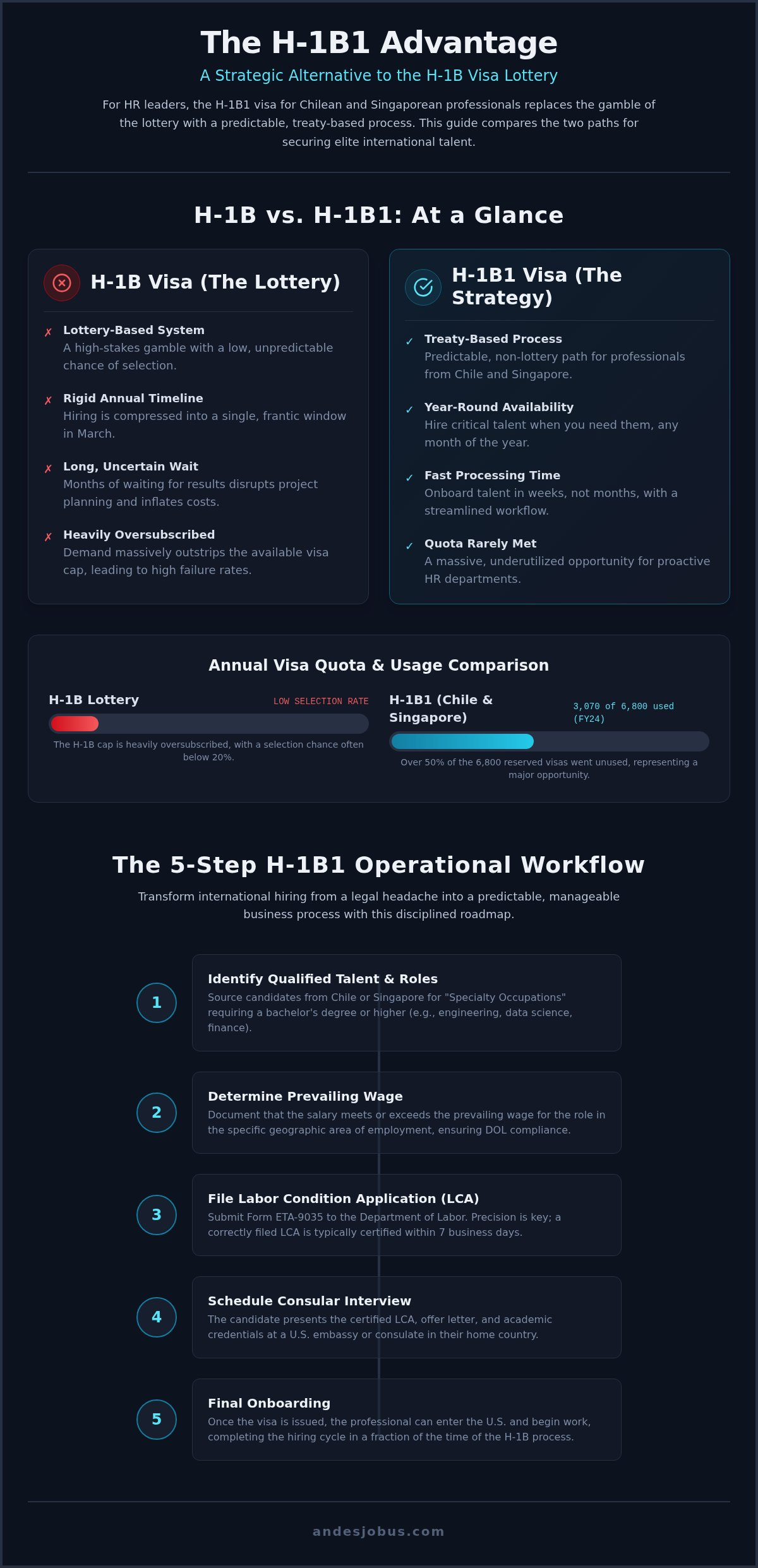
Chile and Singapore are global hubs for high-performance talent in engineering, data science, and finance. The H-1B1 program reserves 6,800 visas annually, with 1,400 specifically for Chile and 5,400 for Singapore. These quotas are rarely exhausted. In Fiscal Year 2024, only 3,070 H-1B1 visas were issued. This represents a massive opportunity for proactive HR departments. The program is designed for professionals in specialty occupations that generally require a bachelor's degree or higher. This includes standard roles like software developers and architects, alongside specific treaty-recognized roles like agricultural managers or management consultants. Because these quotas are part of permanent Free Trade Agreements, the program offers regulatory stability that other visa categories lack. It's a secure way to build a diverse, elite workforce.
Removing the Uncertainty of the H-1B Cap
The standard H-1B lottery is an operational nightmare. It forces HR to compress all international hiring into a single window in March. You then wait months for a result that is often a "no." This uncertainty makes it impossible to plan for critical Q3 or Q4 projects. H-1B1 visa management for HR eliminates these calendar restrictions. You can hire in July, October, or January. There is no lottery entry required. If the candidate is qualified and the documentation is compliant, the visa is accessible. This 100% selection rate restores control to your team. You can focus on sourcing the right expert rather than managing the fallout of a failed lottery entry. It changes the dynamic from a gamble to a predictable business process. You get the talent you need exactly when you need them.
The H-1B1 Operational Workflow: From Sourcing to LCA
Moving from a lottery-based mindset to a treaty-based strategy requires a shift in operational discipline. The process is linear and predictable. Unlike the convoluted H-1B lottery, where success is left to chance, the H-1B1 operational workflow follows a disciplined, five-step roadmap that prioritizes speed and compliance. This roadmap includes role identification, prevailing wage determination, Labor Condition Application (LCA) filing, the consular interview, and final onboarding. Effective H-1B1 visa management for HR ensures each of these stages is handled with project-management precision to avoid the delays that typically plague international hiring.
Step 1: Identifying Qualified Talent and Roles
Success begins with aligning the candidate's credentials with the "Specialized Occupation" requirements defined by the Free Trade Agreements. You're looking for roles that require a bachelor's degree or higher in a specific field. For Chilean and Singaporean talent, this includes standard tech and engineering positions, but the treaty also covers unique categories. For instance, Chilean citizens can qualify as agricultural managers or physical therapists, while both nationalities can enter as management consultants or disaster relief claims adjusters. Sourcing pre-screened candidates who already understand the non-immigrant intent requirement is critical. Your job descriptions must clearly articulate the specialized nature of the role to satisfy Department of Labor standards from the outset.
Step 2: Managing the LCA and Prevailing Wage
The Labor Condition Application is the backbone of your compliance strategy. Before a candidate can attend an embassy interview, you must obtain a certified LCA. This involves a rigorous determination of the prevailing wage for the specific geographic area of employment. You'll need to document that the H-1B1 professional will be paid a wage equal to or higher than what is paid to similarly employed U.S. workers. The U.S. Department of Labor H-1B1 Program guidelines mandate specific record-keeping for these filings. A common pitfall is failing to match the correct SOC code to the job duties, which can trigger a denial. Precision in this stage ensures the LCA is typically certified within seven business days, maintaining your hiring momentum.
By following this methodical approach, you can cut the time-to-fill for critical roles by several months compared to the standard H-1B cycle. Most Chilean and Singaporean experts can be onboarded in eight to twelve weeks. This velocity is only possible when you treat the visa lifecycle as a managed business process. If your team needs to scale quickly without the administrative burden, specialized H-1B1 sponsorship management can turn this workflow into a turnkey solution. H-1B1 visa management for HR isn't just about filing forms; it's about building a reliable pipeline of elite talent that your competitors are likely overlooking.
H-1B vs. H-1B1: Comparing HR Resources and Timelines
Choosing between the standard H-1B and the H-1B1 is the difference between gambling and investing. For most HR departments, the standard lottery is a source of constant friction. It consumes significant administrative resources with no guaranteed return. By contrast, H-1B1 visa management for HR treats talent acquisition as a predictable operational flow. You aren't just filling a seat; you're securing a timeline. This shift allows your team to focus on talent quality rather than administrative survival.
Resource Allocation and Budgeting
The true cost of a failed H-1B lottery entry often approaches $100,000 when you factor in sunk legal fees, recruiter commissions, and the lost productivity of a vacant role. We call this the "lottery tax." Choosing the H-1B1 path allows you to forge that $100k fee by removing the element of chance. Filing fees for H-1B1 are significantly lower because candidates applying from abroad bypass the expensive USCIS petition process entirely. They apply directly at a U.S. consulate with a certified LCA. This makes the H-1B1 an ideal solution for startups and agile mid-market firms that need to manage cash flow while securing top-tier Chilean or Singaporean talent. Shifting your budget from speculative legal fees to disciplined compliance management ensures every dollar spent contributes to a successful hire.
Onboarding Velocity and Project Deadlines
Velocity is a competitive advantage. While the H-1B forces you to wait until October 1st to start a new hire, the H-1B1 operates on your schedule. You can expect a candidate on-site in approximately eight weeks from the time of the initial offer. This speed allows you to align international hiring with specific quarterly goals or product launches. If a critical project starts in June, you don't have to wait for the next fiscal year's lottery. You simply execute the H-1B1 workflow. This removes the "waiting game" that often kills momentum in high-growth environments.
Managing extensions is equally streamlined. While the initial stay is up to 18 months, renewals can be processed in one-year increments. This provides a clear, multi-year path for your employees, which significantly boosts retention. When talent knows their status is secure and not subject to a random drawing, they're more likely to commit long-term. This predictability reduces the stress on your internal team and creates a more stable, high-performing environment. Consider these strategic trade-offs:
- Lottery Risk: H-1B selection rates remain low, meaning your hiring efforts have a high probability of failure before they even begin.
- Compliance Risk: H-1B1 requires strict adherence to Department of Labor standards, but this is a manageable business process rather than a game of chance.
- Timeline Risk: Standard H-1B timelines are rigid and often clash with immediate business needs. H-1B1 offers year-round flexibility.
Best Practices for Maintaining H-1B1 Compliance and Audit Readiness
Compliance is the operational foundation of a successful international hiring program. It's not enough to secure the visa; you must defend it through meticulous record-keeping. Effective H-1B1 visa management for HR requires a proactive stance on documentation, ensuring every file is audit-ready from day one. This discipline protects the organization from federal penalties and ensures the stability of your talent pipeline. You aren't just managing people; you're managing a regulatory lifecycle that demands precision and accountability.
Building a Bulletproof Public Access File
The Public Access File (PAF) is your first line of defense during a Department of Labor (DOL) inspection. For every H-1B1 employee, you must maintain a file that includes the certified LCA, a statement of the actual wage paid, and the methodology used to determine that wage. You also need the prevailing wage documentation and evidence that you've notified your U.S. workforce of the hiring. These files must be accessible within one business day of filing the LCA. You're required to retain these records for one year after the employee leaves or the LCA expires. Whether you use a digital repository or a physical binder, the key is immediate availability and operational order.
Preparing for a DOL or USCIS Site Visit
Surprise audits aren't a matter of "if" but "when." A site visit from the DOL or USCIS doesn't have to be a crisis if your team is trained. Your front-desk staff should know exactly who to call when an officer arrives. Your management team should have a designated spokesperson ready to provide the PAF. Conduct quarterly self-audits to identify gaps in your prevailing wage documentation or offer letters. This internal tracking ensures that 18-month initial stays and subsequent 1-year extensions are monitored well in advance of their expiration windows. Don't wait for a federal notice to discover a missing signature or an outdated wage report.
Establishing these protocols transforms compliance from a source of anxiety into a routine business process. It allows your HR team to focus on talent development rather than administrative damage control. Build a more resilient organization by outsourcing the heavy lifting of compliance and audit documentation to experts who treat your files with the same discipline as your internal team.
Optimizing Your International Talent Pipeline with AndesJobUSA
Building a high-performance team shouldn't be stalled by administrative friction. Most traditional legal consultancies focus on reactive filings, leaving HR teams to manage the logistical fallout. AndesJobUSA operates differently. We act as a seamless extension of your internal team, providing end-to-end H-1B1 visa management for HR that prioritizes operational speed and full compliance. By shifting the focus from legal guesswork to disciplined project management, we allow your leadership to focus on core business objectives while we handle the complexities of international talent acquisition.
A Disciplined Approach to Visa Management
Our methodology is rooted in transparency and accountability. We don't just offer advice; we take ownership of the sponsorship lifecycle. This proactive stance means we track every milestone from the initial Labor Condition Application to the final onboarding date. Working with specialists who understand the nuances of the Chile and Singapore Free Trade Agreements ensures that your talent pipeline remains robust and predictable. You get real-time reporting on every candidate, allowing for better workforce planning and resource allocation. This level of operational clarity is what separates a managed process from a standard administrative service. We replace the uncertainty of the lottery with a rigorous, sequence-driven workflow that delivers results.
Getting Started with Lottery-Free Hiring
The first step in optimizing your pipeline is a strategic audit of your current and future hiring needs. Identify the specialty occupations in your 2026 org chart that could be filled by elite professionals from Chile or Singapore. Whether you need senior software engineers in Santiago or management consultants in Singapore, the H-1B1 visa is your most efficient tool. Our implementation timeline for new corporate partners is designed for speed. We can integrate with your existing HR processes in days, not weeks. We'll help you establish the necessary Public Access Files and documentation standards to ensure your organization is audit-ready from the first hire. It's time to stop gambling on the H-1B cap and start building a predictable talent strategy. Consult with our H-1B1 management experts today to see how we can transform your international recruitment operations.
Transform Your International Hiring Into a Competitive Advantage
The uncertainty of the H-1B lottery doesn't have to dictate your growth strategy. By pivoting to the H-1B1 program, you replace a game of chance with a disciplined business process. You've seen how this treaty-based path offers year-round flexibility, significantly faster onboarding, and reduced administrative costs. Implementing effective H-1B1 visa management for HR ensures that your team remains focused on securing elite talent from Chile and Singapore rather than managing the fallout of failed lottery entries.
Maintaining audit-ready documentation and mastering the LCA workflow are the keys to a resilient international pipeline. As specialists in Chile and Singapore FTA visas, we provide the end-to-end compliance management needed to keep your operations running smoothly. You can now build a predictable hiring timeline that aligns with your quarterly goals. It's time to take full ownership of your recruitment lifecycle. Streamline your H-1B1 management with AndesJobUSA and secure the experts your business needs to thrive. Your next top performer is within reach.
Frequently Asked Questions
Is the H-1B1 visa subject to the annual H-1B lottery?
No, the H-1B1 visa is entirely exempt from the H-1B lottery process. It operates under a separate annual quota of 6,800 visas, with 1,400 reserved for Chile and 5,400 for Singapore. These quotas rarely fill up, allowing your organization to hire qualified professionals year-round without the uncertainty of a random selection. This exemption makes the program a highly predictable tool for strategic workforce planning.
What are the specific requirements for HR to sponsor an H-1B1 visa?
Sponsoring an H-1B1 requires the candidate to be a citizen of Chile or Singapore and the role to qualify as a "specialty occupation." You must obtain a certified Labor Condition Application (LCA) from the Department of Labor before the candidate applies. Unlike the standard H-1B, you don't need to file a formal petition with USCIS if the candidate is applying from outside the United States.
Can H-1B1 visa holders apply for a Green Card (Dual Intent)?
No, the H-1B1 is not a dual-intent visa. Applicants must demonstrate non-immigrant intent, meaning they intend to return to their home country after their stay. While they can seek permanent residency later, it's a more complex process than the standard H-1B. HR teams should factor this into long-term retention strategies to manage employee expectations and maintain full compliance with federal standards.
How long does the H-1B1 visa processing take for US employers?
The entire process typically takes 8 to 12 weeks from the initial offer to the candidate's first day. This timeline is significantly shorter than the H-1B cycle because it bypasses USCIS petition processing. Effective H-1B1 visa management for HR focuses on securing the LCA in approximately seven business days, followed by the candidate's consular interview. This speed allows for rapid scaling of critical technical teams.
What is the difference between H-1B and H-1B1 for specialized occupations?
The main difference is the lack of a lottery and the specific country restrictions. While both require a bachelor's degree for specialty roles, the H-1B1 is reserved for Chilean and Singaporean citizens. It also includes specific treaty-recognized roles like agricultural managers and disaster relief adjusters. The H-1B1 offers a more predictable hiring timeline but requires proof of non-immigrant intent, unlike the dual-intent H-1B visa category.
What documentation does HR need to maintain for an H-1B1 Public Access File?
You must maintain a Public Access File (PAF) for every H-1B1 employee. This file must include the certified LCA, documentation of the prevailing wage, and a clear statement of the actual wage paid. You also need evidence that the U.S. workforce was notified of the hire. Keeping these records organized and accessible within one business day is a core part of disciplined H-1B1 visa management for HR.
Are there specific prevailing wage requirements for H-1B1 employees?
Yes, employers must pay H-1B1 workers the prevailing wage for their specific occupation and geographic area. This wage is determined by the U.S. Department of Labor and ensures that the hiring of foreign professionals doesn't adversely affect the wages of U.S. workers. Precise documentation of this wage determination is essential for maintaining audit readiness and passing potential federal inspections without triggering costly penalties.
Can H-1B1 employees work for multiple US employers?
Yes, H-1B1 professionals can work for multiple employers, but each employer must file its own Labor Condition Application. The visa is employer-specific, so a candidate cannot simply use an existing visa to start a second role. Each company must follow the standard sponsorship workflow to ensure the professional remains in status while performing services for more than one organization simultaneously.

