
What if you could bypass the H-1B lottery odds entirely and secure world-class experts from Chile or Singapore with near-certainty? While most HR teams are paralyzed by the annual lottery cycle, savvy leaders leverage the H-1B1 treaty visa to onboard specialized talent without the wait or the randomness. This speed comes with a strict mandate for precision. Understanding the specific employer responsibilities for H-1B1 visa compliance is the difference between a seamless hire and a costly Department of Labor audit.
You likely feel the weight of administrative overwhelm, especially when navigating the nuances of Labor Condition Applications and Public Access Files. It's frustrating to manage complex paperwork while trying to hit aggressive growth targets in a landscape of shifting regulations, such as the 2026 proposed prevailing wage increases. We'll help you master these specific compliance and documentation obligations for hiring professionals from Chile and Singapore without the H-1B lottery stress. This article provides a clear, operational roadmap for H-1B1 sponsorship, detailing everything from LCA attestations to the exact steps for maintaining an audit-ready Public Access File.
Key Takeaways
- Bypass the H-1B lottery and annual caps by utilizing the treaty-based H-1B1 classification for Chilean and Singaporean professionals.
- Master the specific employer responsibilities for H-1B1 visa management, focusing on the four primary attestations required for Labor Condition Application (LCA) approval.
- Ensure audit readiness by establishing a Public Access File (PAF) within one working day of filing your LCA to meet Department of Labor transparency standards.
- Adopt a disciplined checklist that covers the entire sponsorship lifecycle, from initial prevailing wage verification to final employment termination.
- Optimize your talent acquisition strategy by reducing filing fees and eliminating the high-stakes risks associated with the traditional H-1B lottery system.
Understanding the H-1B1 Framework for US Employers
The H-1B1 visa is a specialized non-immigrant classification born from free trade agreements with Chile and Singapore. Unlike the standard H-1B, which forces companies into a high-stakes lottery, the H-1B1 provides a predictable path for hiring international experts. As the US employer, your role is that of the Petitioner. You take ownership of the process by verifying the candidate’s credentials and attesting to specific labor conditions before the Department of Labor. In 2026, this remains a high-speed alternative for filling technical and professional roles without the administrative friction of cap-related delays.
H-1B vs. H-1B1: Key Operational Differences
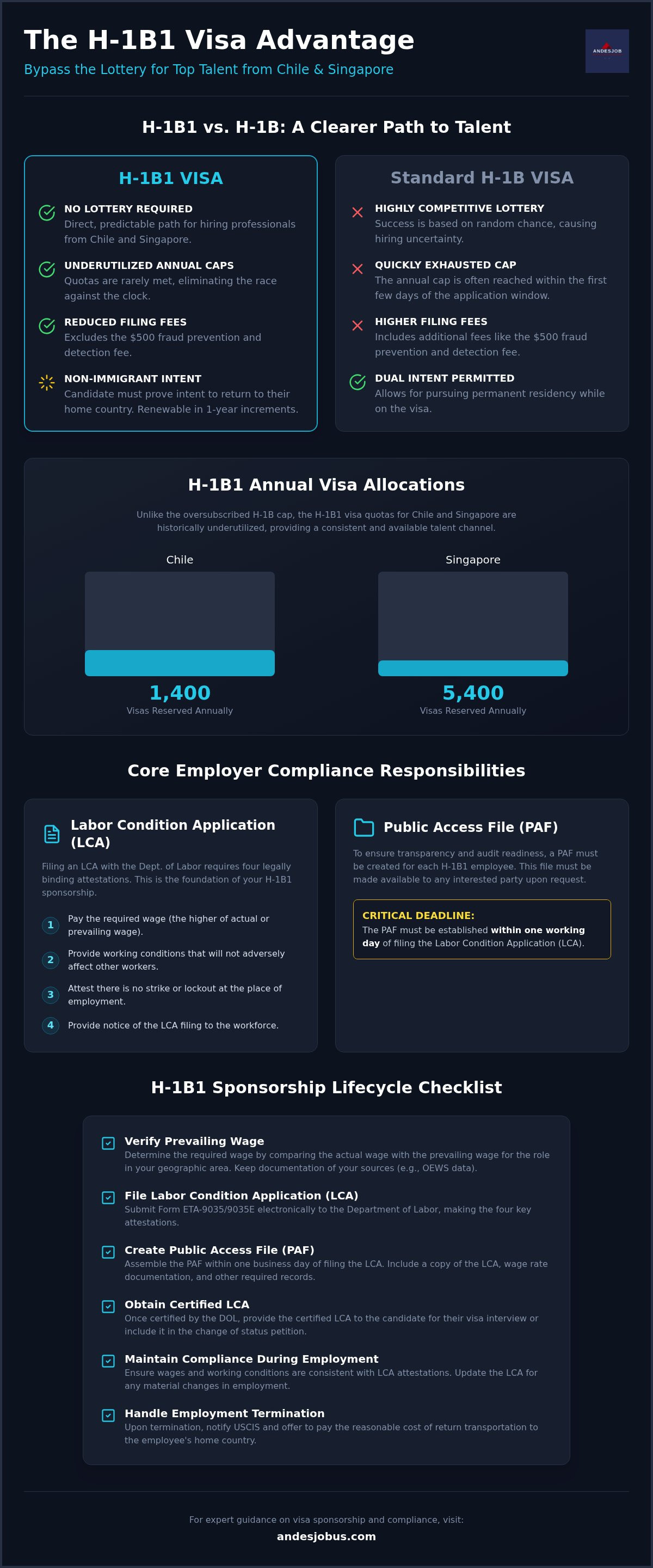
The most significant operational advantage is the elimination of the H-1B lottery. While the standard H-1B cap is often reached within days, the annual limits for the H-1B1, specifically 1,400 for Chile and 5,400 for Singapore, are historically underutilized. This allows for a more disciplined hiring timeline. Employers can choose between consular processing, where the candidate applies directly at a US embassy, or a change of status via Form I-129 if the candidate is already in the US. Unlike the H-1B, which includes a $500 fraud prevention and detection fee, the H-1B1 excludes this cost, though it also lacks a premium processing option. This makes planning ahead essential. It's vital to remember that the H-1B1 requires proof of non-immigrant intent, meaning the worker must demonstrate they don't plan to stay in the US permanently. While it's renewable in one-year increments, the employer responsibilities for H-1B1 visa compliance remain constant throughout the duration of employment.
Qualified Specialty Occupations
To qualify, the role must meet the Department of Labor's definition of a specialty occupation. This typically requires a bachelor’s degree or its equivalent in a specific field of study. However, the H-1B1 offers unique flexibility for certain roles, such as management consultants and disaster relief claims adjusters, who may qualify through alternative experience or certification pathways. You must ensure the job description aligns precisely with these standards to avoid processing delays. Precision in role analysis is a core part of the employer responsibilities for H-1B1 visa sponsorship, ensuring that the candidate's specialized knowledge directly mirrors the operational needs of the business. Aligning your recruitment strategy with these specific criteria allows you to tap into a highly skilled talent pool with minimal regulatory friction.
Labor Condition Application (LCA) and Wage Obligations
The Labor Condition Application (LCA) serves as the legal foundation of H-1B1 compliance, binding the employer to specific workforce standards. When you file this document with the Department of Labor (DOL), you're making four legally binding attestations. These commitments ensure that the employment of a foreign professional doesn't undercut the US labor market. Managing these employer responsibilities for H-1B1 visa programs requires a methodical approach to tracking and documentation. You must secure a certified LCA before the candidate attends their visa interview at a US consulate, as this document is a prerequisite for visa issuance.
Wage parity is the most scrutinized aspect of the process. You're required to pay the "required wage," which is the higher of the actual wage paid to other employees with similar experience or the prevailing wage for the occupation in the specific geographic area. Calculating the actual wage involves a granular review of the salaries paid to all other individuals with similar experience and qualifications for the specific employment in question. As of August 2026, employers must remain vigilant regarding the proposed DOL rule from March 27, 2026, which aims to increase prevailing wage percentiles across all tiers. For a streamlined approach to these complex filings, consider professional sponsorship management to ensure your data remains audit-ready and compliant with evolving standards.
The Prevailing Wage Requirement
To establish the prevailing wage, you'll typically consult the Occupational Employment and Wage Statistics (OEWS) survey data as outlined in the H-1B1 Program Requirements. Documentation is your primary defense during a DOL audit. You must maintain records showing how you calculated the actual wage and the source used for the prevailing wage determination. This obligation extends beyond base salary; you must provide the H-1B1 professional with the same benefits package offered to your US-based staff, including health insurance, retirement contributions, and bonuses.
Working Conditions and Strike Protections
Your third and fourth attestations focus on workplace stability and transparency. You must certify that hiring the professional won't adversely affect the working conditions of similarly employed US workers. Additionally, you must provide notice of the LCA filing to your current workforce. This involves posting the notice in two conspicuous locations at the place of employment for at least ten days or providing electronic notice to all employees in the same occupational classification. Finally, you must verify that no strike, lockout, or work stoppage is in progress at the time of filing. These employer responsibilities for H-1B1 visa holders ensure that your recruitment efforts don't interfere with domestic labor relations or standard workplace protections.
Maintaining the Public Access File (PAF) and Audit Readiness
Compliance isn't a one-time event; it's a continuous operational requirement. Once you file the Labor Condition Application (LCA), a countdown begins. You must have a complete Public Access File (PAF) ready for inspection within exactly one working day of that filing. This isn't a suggestion. It's a strict regulatory mandate. Failing to meet this window leaves your organization vulnerable to penalties during a Department of Labor inspection. Mastering the employer responsibilities for H-1B1 visa programs means moving away from reactive filing toward a disciplined, preemptive documentation strategy.
In 2026, the standard for audit readiness is a secure, digital-first filing system. While physical files are technically permitted, they are difficult to track and update across multiple worksites. A centralized electronic repository ensures that your compliance team has immediate access to the necessary records during an unannounced visit. You should establish internal audit protocols to review these files quarterly. This proactive management removes the uncertainty often associated with federal oversight and ensures your documentation remains as dynamic as your workforce.
Essential Components of the PAF
A compliant PAF must contain specific evidence as defined by the Federal Regulations for H-1B1 Employers. You cannot afford to miss a single document. Your file must include the certified LCA, a clear statement of the wage rate paid to the professional, and a detailed summary of the methodology used to establish the actual wage. Additionally, you must include a summary of the benefits offered to the H-1B1 worker, ensuring they mirror those provided to US employees. Finally, include proof that you followed the internal notification process, such as a copy of the physical or electronic posting used to inform your existing staff of the filing.
Storage and Retention Rules
The location of your records matters as much as the content. You must keep the PAF at either your principal place of business or at the actual worksite where the H-1B1 professional is employed. Retention periods are equally rigid. You are required to keep these files for at least one year beyond the end of the employment period or the expiration of the LCA. If a Department of Labor "Project Firewall" audit occurs, the inspector will look for a clear, chronological history of compliance. Maintaining this level of organization isn't just about avoiding fines. It's about demonstrating that your company operates with the high degree of integrity and discipline required to manage specialized international talent.
The H-1B1 Employer Responsibility Checklist: From Filing to Termination
Managing the lifecycle of a foreign professional requires more than just an initial filing. It demands a rigorous, sequence-driven approach to stay within federal guidelines. These employer responsibilities for H-1B1 visa holders start months before the first day of work and continue until the final day of the contract. Following a disciplined checklist ensures that no compliance gap puts your organization at risk. This structured workflow allows your team to focus on talent integration rather than administrative troubleshooting.
- Step 1: Role Analysis. Map the position to a Department of Labor specialty occupation code and verify the prevailing wage against the 2026 OEWS data.
- Step 2: LCA Filing. Submit the Labor Condition Application and complete the 10-day internal notification period at the primary worksite.
- Step 3: Specialty Occupation Documentation. Gather evidence showing exactly how the candidate’s degree or specialized experience qualifies them for the specific role.
- Step 4: PAF Maintenance. Update the Public Access File immediately with any wage increases, benefit changes, or corporate restructures.
- Step 5: Termination Protocol. Meet return transportation obligations if the employment relationship ends before the visa's expiration date.
Pre-Filing Operational Steps
Efficiency begins with a clear schedule. Before you draft an offer letter, you must conduct a thorough H-1B1 visa sponsorship timeline check to align with your project milestones. If your company hasn't sponsored a treaty-based worker before, you'll need to secure FEIN verification from the DOL. This verification is a prerequisite for filing the LCA and can add several days to your start date if not handled early. Ensure your offer letter includes specific language stating the employment is contingent upon visa approval and is strictly employer-specific.
Ongoing Compliance Management
Your obligations don't end once the visa is stamped. You must track material changes in employment, such as a shift in work location to a different metropolitan area or a significant change in job duties. If the professional moves to a new worksite outside the original geographic area, you must file a new LCA to remain compliant. Many HR departments find that partnering with H-1B1 visa sponsorship management experts helps them maintain this level of precision without draining internal resources. If you decide to terminate the employee before their visa expires, remember that you are legally responsible for the reasonable cost of their return transportation to Chile or Singapore. This is a critical, often overlooked part of the employer responsibilities for H-1B1 visa sponsorship.
If you're ready to secure elite talent with a disciplined, audit-ready process, get started with our H-1B1 compliance services today.
Strategic Management: Bypassing the H-1B Lottery Complexity
Traditional H-1B sponsorship often feels like a game of chance rather than a recruitment strategy. The annual lottery creates a bottleneck that stalls corporate growth and leaves critical roles unfilled for months. By shifting your focus to treaty-based options, you replace this uncertainty with a disciplined, predictable business workflow. This transition allows your leadership to build a reliable talent pipeline from Chile and Singapore, ensuring that specialized expertise arrives exactly when your projects require it. Taking full ownership of employer responsibilities for H-1B1 visa compliance is the key to unlocking this high-speed alternative.
AndesJobUSA acts as a seamless extension of your internal team to automate the administrative burden. We handle the granular details of international talent sourcing and the critical compliance documentation that often overwhelms HR departments. Our methodology turns complex federal requirements into a manageable, transparent process. By removing the guesswork from international hiring, we provide a more rigorous and accountable service model that challenges the status quo of traditional legal consultancies. We take full responsibility for the logistics, allowing you to focus on your core business objectives.
Cost-Effective International Hiring
The standard H-1B process carries a significant "lottery tax" on business growth. Companies frequently face massive fee risks, potentially losing thousands in preparation costs for petitions that are never even selected. In contrast, the H-1B1 process offers a streamlined path with near-certainty for qualified candidates. Leveraging AndesJobUSA for risk-free international hiring means you avoid the sunk costs and administrative waste associated with the annual lottery cycle. We focus on specialized talent from treaty countries where the annual caps, 1,400 for Chile and 5,400 for Singapore, are historically underutilized. This ensures your capital is invested in confirmed hires rather than statistical probabilities.
Operationalizing Your Visa Strategy
Moving from reactive hiring to a proactive treaty-country strategy requires a shift in mindset. Instead of waiting for the annual H-1B window, you can onboard experts throughout the year as your operational needs evolve. Integrating H-1B1 management into your existing HR tech stack ensures that every Labor Condition Application and Public Access File is tracked with precision. This level of organization protects your company from the scrutiny of Department of Labor audits and wage-parity challenges. Your next step toward a more efficient, disciplined recruitment model is clear. Schedule a consultation for H-1B1 management to finalize your operational roadmap and master the employer responsibilities for H-1B1 visa sponsorship today.
Securing a Predictable Path to Specialized Talent
Transitioning from the annual H-1B lottery to the H-1B1 treaty visa represents a strategic shift that replaces high-stakes uncertainty with operational precision. You now possess a clear roadmap for managing complex Labor Condition Applications and maintaining a Public Access File that stands up to rigorous federal scrutiny. Mastering the employer responsibilities for H-1B1 visa compliance ensures your organization taps into the elite talent pools of Chile and Singapore without the typical administrative friction or cap-related delays. This disciplined approach transforms international hiring from a gamble into a manageable business workflow.
We take full ownership of the sponsorship lifecycle to ensure your international hiring is both efficient and audit-ready. Our team provides specialized sourcing from Chile and Singapore while managing every stage of the documentation process, allowing your leadership to focus on core business objectives. Bypass the H-1B Lottery with AndesJobUSA and implement a more disciplined, predictable recruitment model today. You've built the foundation for a global workforce; it's time to execute with absolute confidence.
Frequently Asked Questions
Do I need to pay the $100,000 H-1B fee for an H-1B1 worker?
You don't have to pay the massive fees associated with standard H-1B lottery risks. The H-1B1 program is a cost-effective alternative that excludes the $500 fraud prevention and detection fee. While you're still responsible for standard filing fees if choosing a change of status within the US, the primary savings come from avoiding the sunk costs of multiple lottery entries. This makes the H-1B1 a high-performance choice for hiring from Chile and Singapore.
How long is the H-1B1 visa valid for US employers?
The H-1B1 visa is initially valid for a maximum of one year. However, you can renew it indefinitely in one-year increments. Unlike the standard H-1B, which has a six-year limit, the H-1B1 allows for long-term employment as long as the worker maintains non-immigrant intent. Your employer responsibilities for H-1B1 visa maintenance include filing a new Labor Condition Application (LCA) for each extension to ensure continuous compliance.
What happens if I fail an LCA audit for an H-1B1 employee?
Failing an audit leads to severe operational and financial consequences. The Department of Labor can impose civil money penalties up to several thousand dollars per violation and mandate the payment of back wages. In extreme cases of willful non-compliance, your company could be debarred from all foreign labor certification programs for at least one year. Maintaining an audit-ready Public Access File is your best defense against these business-disrupting penalties.
Can an H-1B1 worker eventually transition to a Green Card?
Transitioning is possible but requires a disciplined strategy. Because the H-1B1 requires the applicant to demonstrate non-immigrant intent, filing for a Green Card directly can jeopardize their status. Most companies transition the worker to a dual-intent visa like the standard H-1B first. This requires careful coordination between your HR team and specialized management partners to ensure the timing of the immigrant petition doesn't conflict with the H-1B1's strict requirements.
Is the employer responsible for the H-1B1 employee’s return travel costs?
Yes, the employer must cover reasonable return transportation costs if the employee is terminated before the visa expires. This obligation mirrors the standard H-1B rules. However, if the employee resigns voluntarily or their visa simply expires at the end of the contract, you aren't responsible for these costs. Tracking these employer responsibilities for H-1B1 visa holders ensures your termination protocols remain legally sound and financially predictable.
How does the H-1B1 prevailing wage differ from the standard H-1B?
The prevailing wage methodology is the same, but you must monitor current 2026 regulatory shifts. Both programs use the Department of Labor's four-tiered structure based on geographic location and job complexity. As of August 2026, you must account for the proposed rule from March 27, 2026, which aims to increase these wage percentiles. This means your wage obligations for an H-1B1 hire will align with the most recent OEWS survey data.
Can I sponsor an H-1B1 worker for a part-time position?
You can sponsor a professional for a part-time role. The Labor Condition Application (LCA) allows you to specify whether the position is full-time or part-time. If you choose part-time, you must specify the exact number of hours per week on the LCA and pay the prevailing hourly wage. This flexibility is ideal for specialized consultants or project-based experts who don't require a traditional 40-hour workweek to deliver high-value results.
What documents must be in the Public Access File for an H-1B1 visa?
Your Public Access File must contain four core documents. This includes the certified LCA, a statement of the actual wage paid, a summary of the prevailing wage source, and proof that you satisfied the internal notice requirement. You must also include a summary of the benefits offered to the H-1B1 worker. Having these documents organized in a digital repository within one working day of filing ensures you meet the strict transparency standards required by federal law.


